






Tailor-Made Fabric Ducting Solution for Chamdor
When the Chamdor Faktry Sales fabric warehouse in Northriding expanded, it was time to upgrade its HVAC system as well. The question was how to cool such a massive space efficiently and economically. The answer was a tailor-made fabric ducting solution from FabricAir.
Chamdor Faktry Sales originally started in Chamdor, Krugersdorp. Since then, this family-owned fabric retailer has grown exponentially, boasting “Africa’s largest fabric warehouse and retail outlets”. Besides Krugersdorp, it also has outlets in Edenvale, Newcastle and Northlands Deco Park, Northriding. The Northriding operation covers nearly 6,000 m² and is the biggest of the four.
The Challenge
The Northriding outlet was originally 4,255 m² in size. It offered everything from upholstery and curtain accessories to bridal fabric, towels and everything in between. Basically, the outlet was a large warehouse space with ceilings more than 6 m high.
Chamdor quickly outgrew the premises. As a result, the owners bought the 1,276 m² space next door to expand into, which used to be an action cricket arena. However, there was a height difference between the buildings, and a 460 m² link had to be built. This link later proved the biggest challenge for the design team.
During this time, the client also decided to upgrade its cooling solution. Chamdor brought on board Cassie Joubert of Thaba Air, who had previously done work for the Krugersdorp store. Thaba Air then approached Energy Partners (EP) to facilitate the detailed design and regulatory compliance. Wimpie Swiegers of EP in Irene provided the detailed design, with Ruan Jansen van Rensburg of EP assisting in the process.
The old HVAC system consisted of undersized evaporative cooling units connected to galvanised spiral ducting. Supply grilles did not provide adequate air distribution. Moreover, because the system was undersized, it could not keep the building under positive pressure.
The client needed a practical and cost-efficient cooling and ventilation solution that avoided draughts or dead spots on the trading floor. The store also had to remain operational. Downtime had to be avoided, so the entire installation took place while trading continued uninterrupted.
The Solution
The design team installed a full fresh air evaporative cooling system with fabric ducting, serving the combined area of 5,991 m². New Cool Breeze FD500 twin-fan evaporative cooling units were installed. These coolers have a double function and can also operate in fan-only mode.
Selecting the new evaporative cooling units wasn’t the biggest challenge. Instead, the real difficulty was the size and quantity of ducting needed to run the system efficiently. Keeping the store trading throughout construction made this even harder. With rigid ducting, the amount required to ventilate the combined space adequately would have been exorbitant. For this reason, the design team decided to look into a fabric ducting solution.
FabricAir offered the best solution at the lowest cost, and Thaba Air selected its product. The customer bought into the concept and was particularly interested in being able to customise the colours of the ducting.
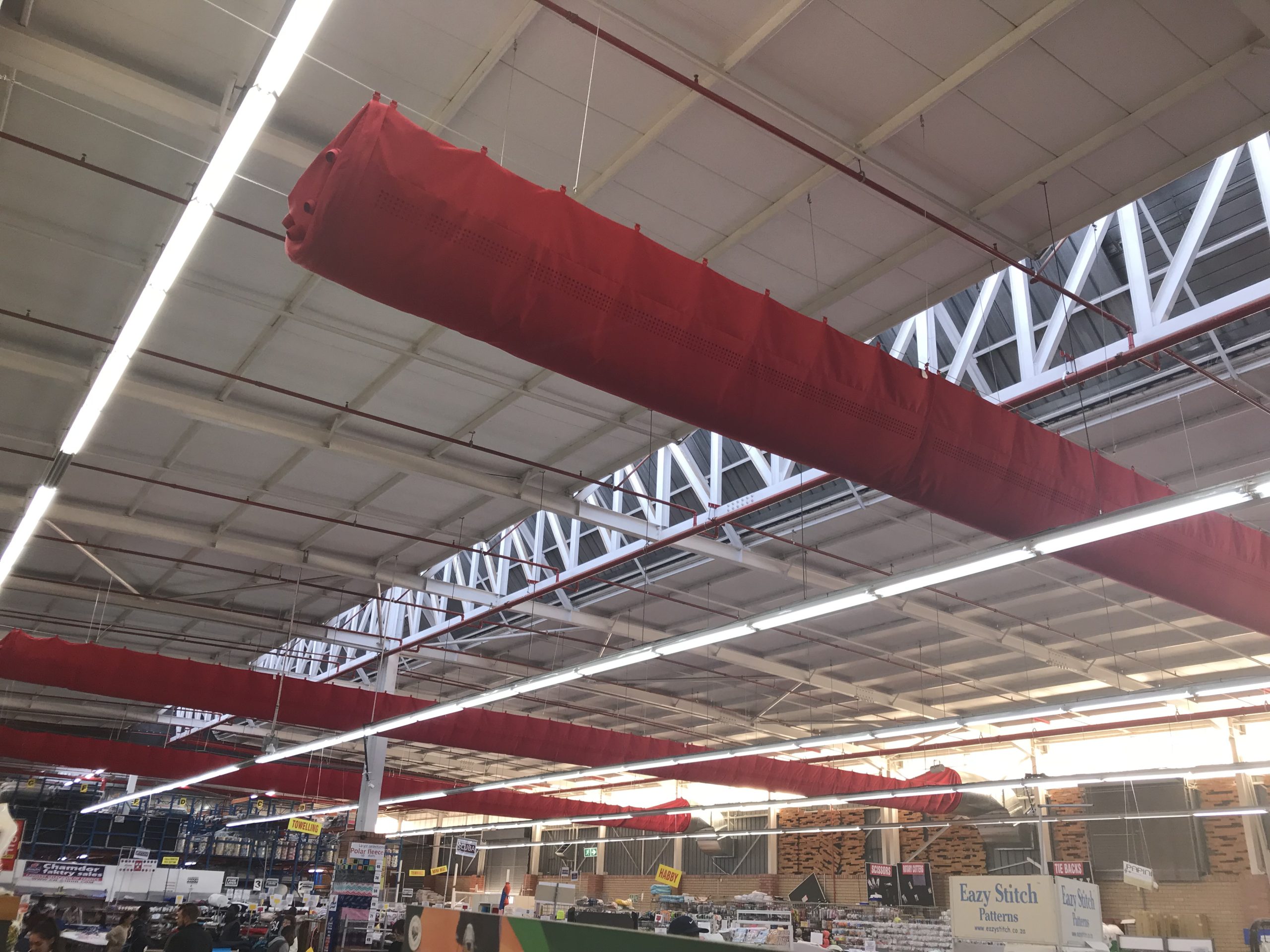
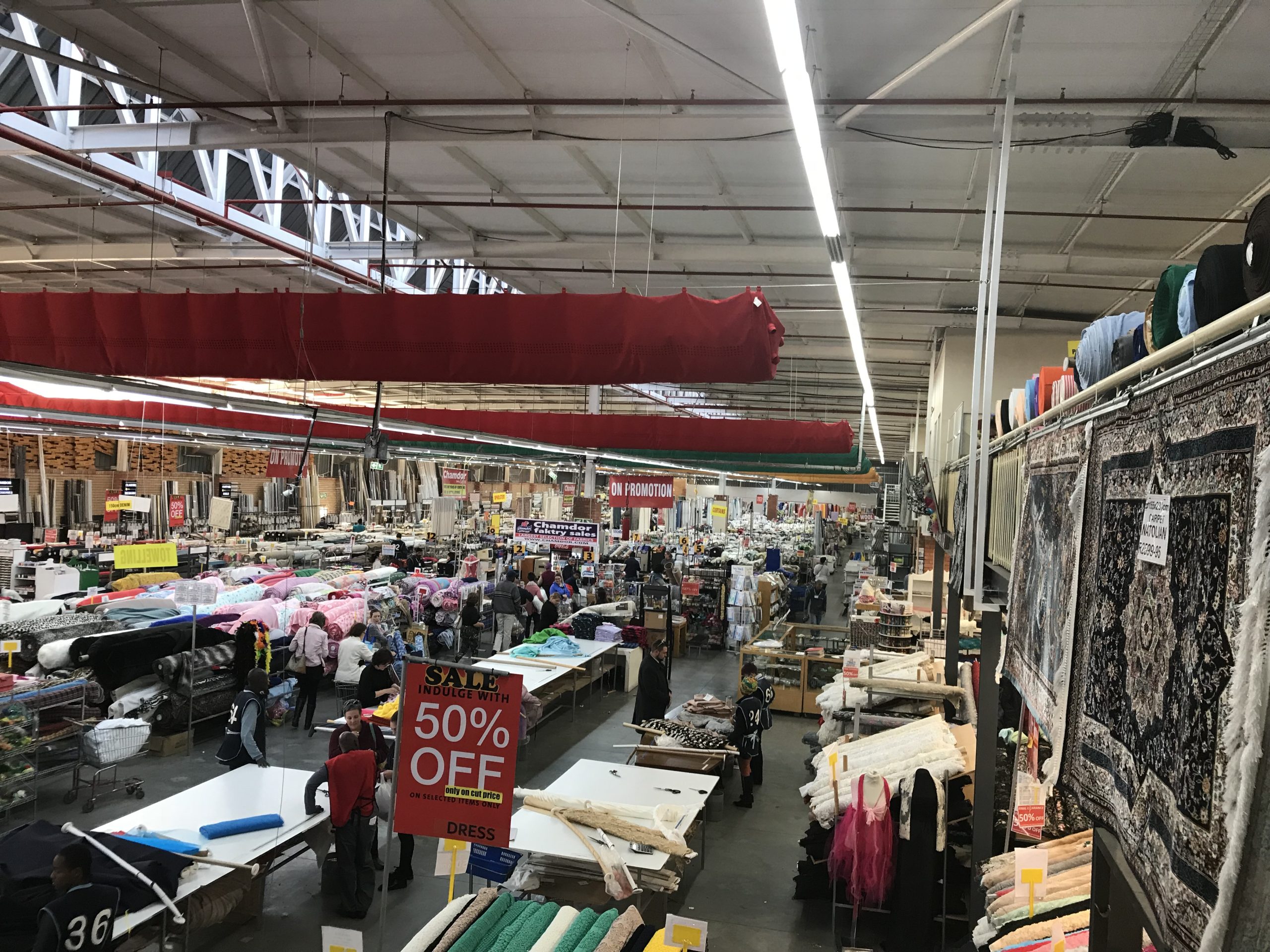
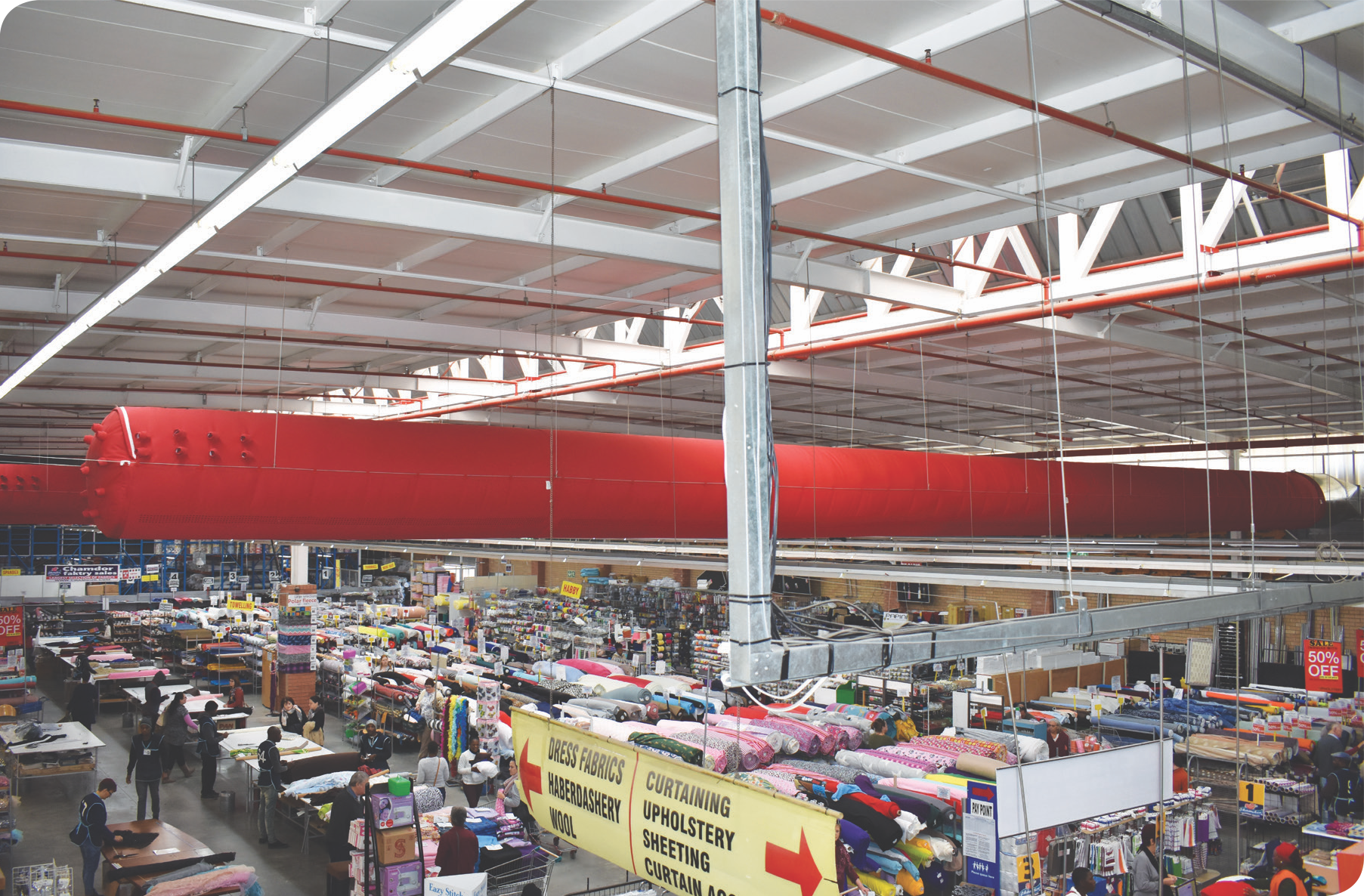
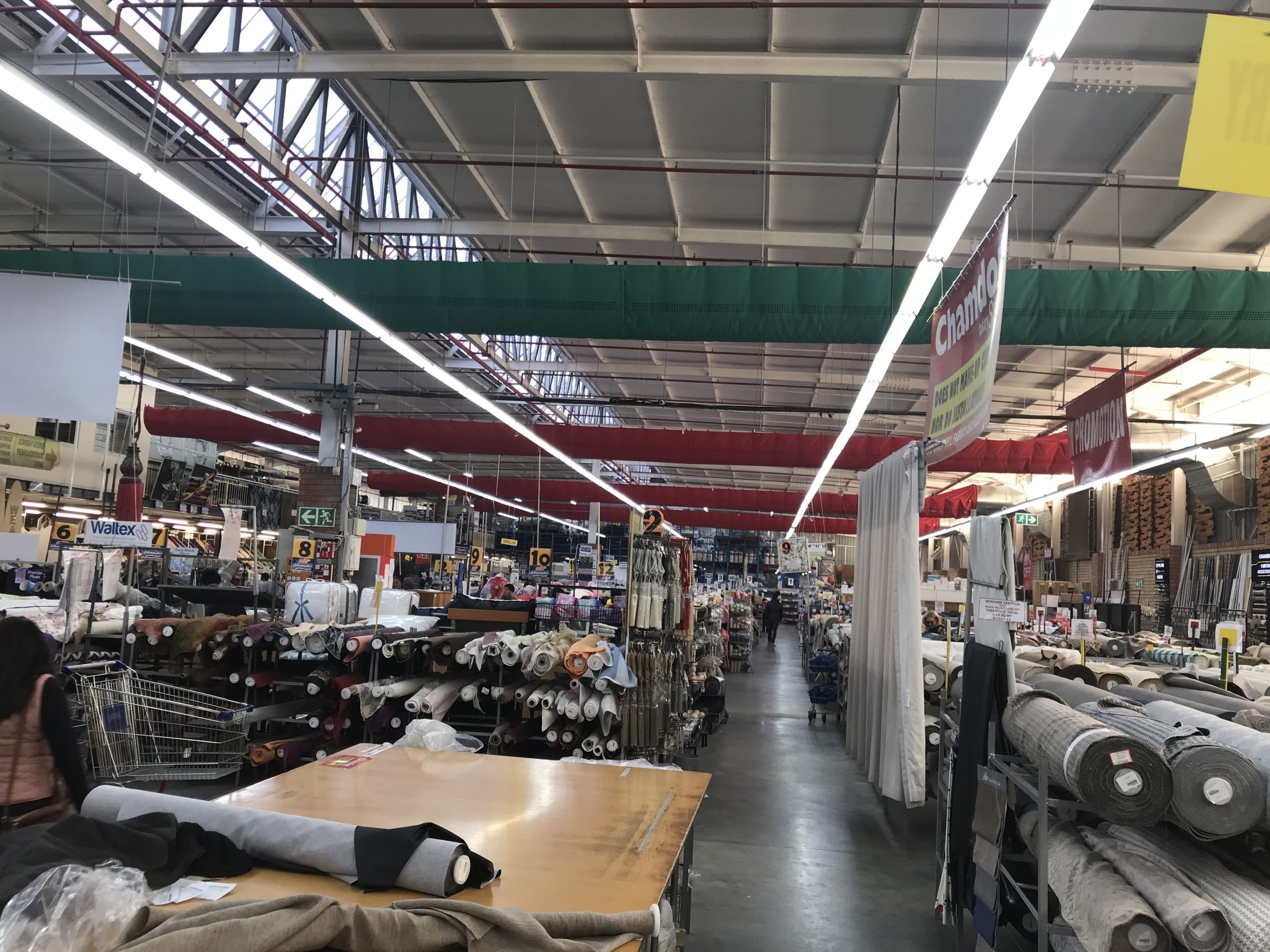
In total, 13 systems went in, each colour-coded depending on the area. The 1.2 m diameter ducts range in length between 21 m and 23 m. Each run has three pieces of ducting that zip together, and the stop end is also zipped on.
The ducting is perforated. As a result, it distributes the air evenly instead of dumping it in select spaces through conventional supply grilles. Even the perforation patterns and specifications can be customised to fit each application. Nozzles on the ducts also allow the air to reach the mezzanine level.
For this project, the team used a non-permeable fabric, as it suits evaporative cooling. For mechanical air-conditioning applications, a permeable fabric would be selected to avoid condensation forming in the fabric itself. This particular solution is available in nine optional colours.
The fabric ducting runs at a height of 4.2 m from finished floor level. Functionality tests showed that the facility receives cool air without discomfort from draughts. The air distribution is balanced to avoid hotspots, while providing enough air movement for customer comfort.
The biggest installation challenge was that there was nothing to fix the fabric ducting to. Therefore, Thaba Air had to build brackets first. The team on site consisted of nine people: a supervisor and two teams of four working at heights. They made and hung the brackets and ducting. These teams also installed the mounting brackets for the evaporative cooling units on the outside of the building.
In terms of controls, the system is quite straightforward. Each system can be activated individually, depending on the need. The controls for each unit are wall-mounted close to its evaporative cooling unit. In addition, every second system is connected to the emergency generator’s power supply. In the event of a power outage, half of the installed units will still be operational.
Why FabricAir
Virtually anything that can be done with sheet metal can also be done with fabric, only much quicker and easier. Various fabric materials are available, depending on the application. From heating to refrigeration, and from -18 °C to 140 °C, there is a fabric to suit every need. There are even anti-microbial options for installations like abattoirs, or anti-static options for projects where a fire risk exists.
Joubert did a costing exercise for this job. In terms of material, he found little difference between rigid ducting and fabric ducting. However, the massive cost saving came on the time and labour side. Rigid ducting would also have required large grilles, making it even more expensive. On top of that, putting up sheet metal ducting while the store was trading would have taken more than double the time.
Another big advantage is that fabric ducting takes up very little space in transport. It all fits into a box that can travel in the back seat of a car. Rigid ducting, by contrast, would have required a 10-tonne truck and forklifts. Maintenance is also simple: the ducting is removed and cleaned in an industrial washing machine.
“This solution was definitely the right one for this project,” says Jansen van Rensburg. Because the space to be air-conditioned is so large, alternatives such as rooftop units or large ducted split units would have been considerably more expensive.
According to Jansen van Rensburg, evaporative cooling works well in Gauteng because the climate is dry. It would not have been an effective solution in KwaZulu-Natal, for example. At the Chamdor Faktry Sales location, however, evaporative cooling combined with fabric ducting was a feasible solution. Since the units are mounted on brackets on the side of the building, the system also did not require a plant room.
The client is very happy with the outcome. After all, a fabric ducting solution is almost poetic for a fabric outlet store. Chamdor also has plans to extend the premises even further in the future.
Discover our solutions for shopping centres, stores and food markets.
Explore our commercial ducting systems.
Browse more case studies.
Contact FabricAir South Africa to discuss your project.