







Setting New Standards for Hygiene
At Sadef Food’s production facility in Turkey, food safety is not treated as a checklist item. It is a continuous process that begins the moment raw materials arrive and extends all the way to product dispatch. While surface cleanliness is essential, Sadef Food understands that true hygiene control depends on what cannot always be seen: the air moving through the facility.
In today’s global food supply chain, major retailers and international brands increasingly require suppliers to demonstrate compliance with GFSI-recognized standards such as BRCGS, FSSC 22000, SQF, and IFS. For manufacturers, this means proving not only product quality, but also full control over the production environment, including HVAC systems.
Air distribution, often overlooked, plays a decisive role in protecting product integrity. Traditional metal ductwork can present challenges in hygiene-sensitive environments, particularly when it comes to condensation, cleaning, and airflow control. For Sadef Food, fabric ducting emerged as a clear alternative, offering faster installation, easier maintenance, and greater adaptability to strict hygiene requirements. FabricAir was tasked with designing an air distribution system that would meet the facility’s strict hygiene standards while also addressing energy efficiency, long service life, and employee comfort.
Tailor-Made System Design
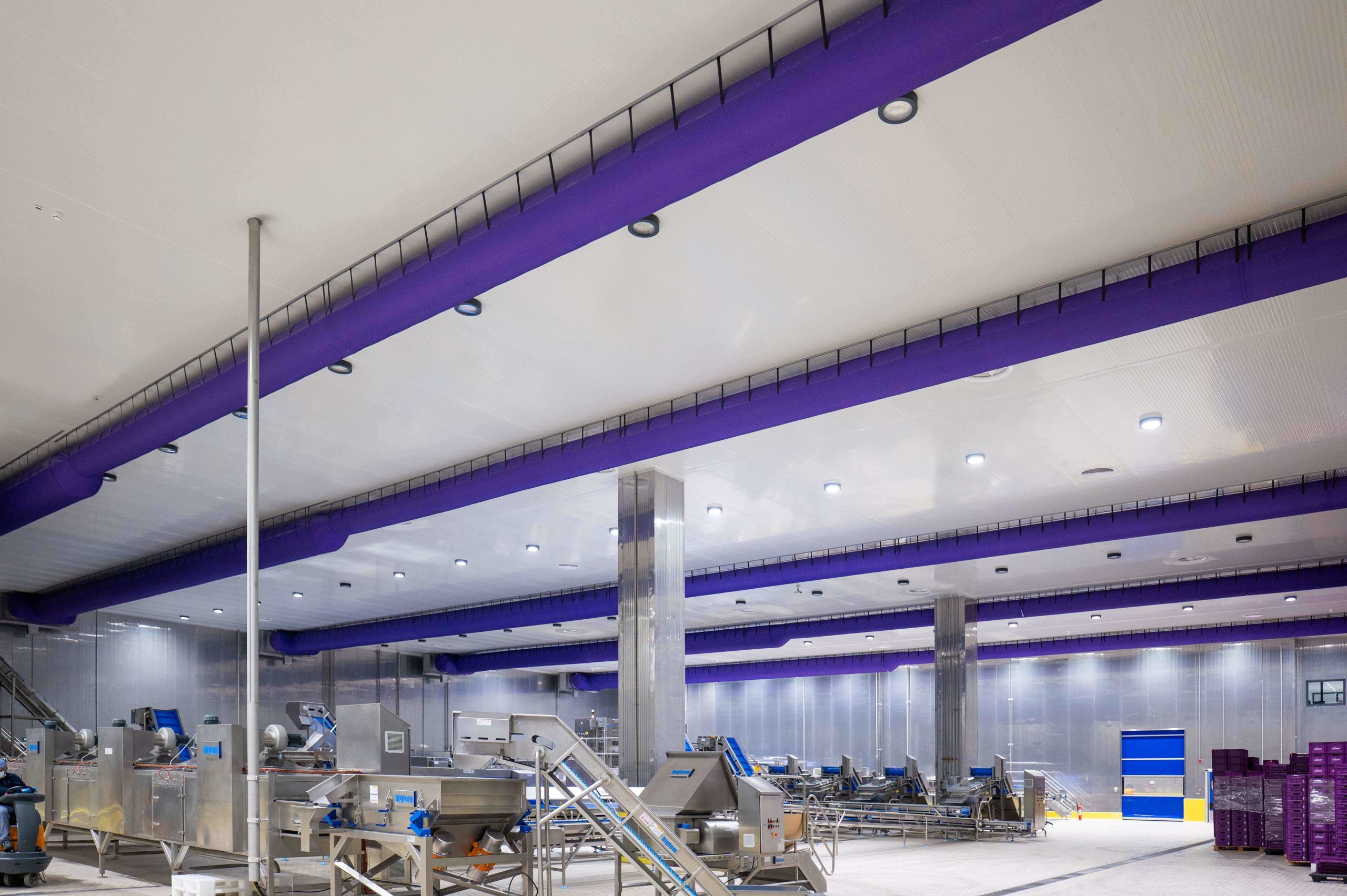
FabricAir developed a customized fabric ducting solution covering five distinct zones within the facility, each with its own operational demands. In total, 447 meters of fabric ducting were installed, distributing 231.683 m³/h of air at low velocity with uniform dispersion.
The result was a highly stable indoor climate, with temperature differences across production areas reduced to as little as ΔT 0,5 °C. This consistency supports both product protection and overall food safety. Operating at just 80 Pa of external static pressure, the system also significantly reduced fan load, translating into measurable energy savings.
Fabric Selection and Hygiene Criteria
At the core of the system is FabricAir’s Combi 80 fabric, selected specifically for hygiene-critical environments. Combi 80 is compatible with ISO Cleanroom Class 3 standards and features antibacterial properties alongside controlled air permeability, making it well suited for food processing facilities.
Its benefits include resistance to condensation, inhibition of microbiological growth on both inner and outer surfaces, and full washability, even under frequent cleaning cycles and exposure to cleaning chemicals. Unlike metal ducting, the fabric does not corrode, helping maintain long-term hygiene performance.
Beyond technical performance, the ducts were produced in custom colors aligned with Sadef Food’s brand identity, ensuring visual cohesion throughout the production areas.
Precision Airflow Where It Matters
To meet the varied needs of different production zones, FabricAir employed three airflow principles: MicroFlow, SonicFlow, and FabFlow. Each was selected based on the specific operational conditions of the area.
MicroFlow supplies air gently through small perforations along the duct, allowing cooler air to descend slowly while warmer air is displaced upward, creating a stable, draft-free environment. SonicFlow uses precisely angled laser-cut openings to deliver targeted airflow where higher velocities are required. FabFlow distributes air through the permeable fabric surface itself, minimizing drafts while enhancing thermal comfort and reducing dust accumulation and condensation risks.
Together, these airflow models ensured even distribution without perceptible drafts, improving working conditions along production lines. In colder zones, the low-velocity delivery helped reduce cold-related discomfort—an issue often associated with traditional metal duct systems, contributing to better employee comfort and potentially lower sick leave.
Built for Easy Cleaning and Long-Term Use
The system is suspended using a Type 4 T-rail suspension, allowing ducts to be removed and reinstalled quickly for cleaning without special tools. Anodized aluminum rails and stainless-steel components eliminate corrosion risks and prevent the formation of cracks or residues where bacteria could accumulate.
This design supports frequent cleaning cycles while maintaining the hygienic integrity required in food production environments.
Measurable Results
The FabricAir solution delivered tangible benefits across multiple performance areas:
- Energy efficiency: High performance at just 80 Pa external static pressure
- Indoor air quality: Even, draft-free airflow and stable temperatures
- Hygiene sustainability: Washable fabric compliant with ISO Cleanroom Class 3
- Visual integration: Custom colors aligned with corporate branding
As a result, the FabricAir ducts served not merely as air distribution solution but as an engineering asset that brought together food safety, process stability, and operational efficiency within a single integrated design.