








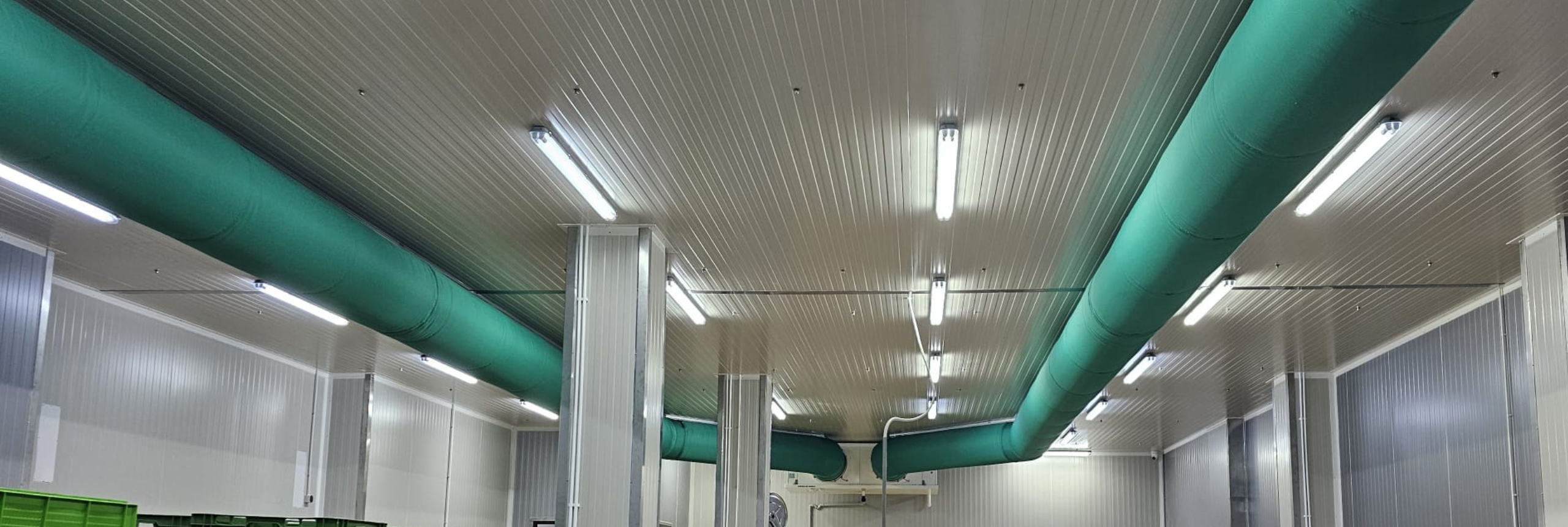
Achieving 40% Energy Savings with Fabric Ducts Instead of Metal


This article explains how fabric air ducting delivers up to 40% greater energy efficiency compared to traditional metal ductwork. You’ll learn how fabric air dispersion systems reduce pressure loss, optimize airflow, and minimize the power required for HVAC operation—resulting in substantial energy savings. It highlights key comparisons between metal and fabric systems, demonstrating how custom-engineered air distribution through perforations and nozzles ensures even temperature control and faster heat transfer. By the end, you’ll understand why replacing metal ducts with fabric air ducts offers not only lower operational costs but also improved thermal performance and sustainability for modern industrial and commercial buildings.
HVAC systems have a significant impact on the energy efficiency of a building. These systems are vital for maintaining a comfortable indoor environment but are also major consumers of energy. Energy efficiency is vital for reducing operational costs, minimizing environmental impact, ensuring regulatory compliance, and enhancing overall system performance.

Lauris Rezgals-Kalpmanis
Group Product Manager, Europe
Traditional metal duct systems use metal diffusers positioned in different intervals to direct airflow to the occupied space. Alternatively, fabric air dispersion systems (also known as duct socks or cloth ducting) are custom engineered to disperse air precisely where it is needed at any location along the circumference of the duct. These systems not only reduce energy consumption significantly but also offer a range of other benefits.
Comparing Fabric Air Dispersion with Traditional Metal Ductwork
In a typical industrial setting, metal ductwork systems can be quite inefficient. For instance, in a room measuring 25 x 25 meters, distributing air evenly across 625 square meters can be challenging. Metal ducts often use swirl diffusers spread across the ceiling, which can result in high pressure losses and uneven air distribution.
Where Does Pressure Loss Occur in Metal Ducts?
Most metal ductwork systems (example in Figure 1) have several branches that lead to various pressure losses.

Figure 1.
The critical path (the path with the highest total pressure loss, highlighted in yellow in Figure 1) was identified to have a pressure loss of 135.8 Pa.
To balance the system, additional regulating dampers are required, increasing the total pressure loss to 160.8 Pa. (Figure 2)

Figure 2.
These high-pressure losses lead to higher energy consumption as the system needs more power to maintain the desired airflow.
The Fabric Air Dispersion Advantage
Fabric air dispersion systems, on the other hand, offer complete flexibility in air distribution. These systems use specially designed fabrics and custom engineered airflow through laser cut holes or perforations, nozzles, and jets to distribute air precisely where it is needed. With custom engineered airflow, a single straight duct in the center of the room (Figure 3) can distribute air across the entire space at comfortable air velocity.

Figure 3.
Here’s why they’re more efficient:
Pressure Loss in Fabric Air Ducts
Fabric air ducts have significantly lower pressure losses compared to metal ducts due to their efficient design and custom airflow.
At a design static pressure of 120 Pa, the total pressure loss is 128.5 Pa (Figure 4)

By reducing the static pressure to 100 Pa, the total pressure loss can be further decreased to 110.8 Pa (Figure 5).

This reduction in pressure loss directly translates to lower energy consumption. For the same airflow (8000 m3/h), fabric air ducts require less fan power, leading to substantial energy savings.
Quantifying the Energy Savings
Using the same fan for both systems, here’s a comparison of energy consumption:
Fan Working Parameters:

As you can see, fabric air dispersion systems can reduce energy consumption by up to 42.8% compared to conventional metal ductwork.
Thermal Performance: Another Win for Fabric Air Ducts
The benefits of fabric air ducts don’t stop at pressure loss. Their unique design also leads to better thermal performance:
- Fabric air ducts can distribute air through a much larger surface area, ensuring more even and efficient air distribution.
- Studies have shown that fabric air ducts heat rooms faster and more uniformly than metal diffusers. [1]
- Unlike metal diffusers, which often cause air to stay along the ceiling and escape, fabric air ducts ensure more energy is absorbed by the room, increasing heating efficiency by 24.5%.
Conclusion: Over 40% Energy Savings
Combining the positive effects on energy consumption from reduced pressure drop and improved thermal performance, fabric air dispersion systems can lead to more than 40% energy savings compared to conventional metal ductwork systems. This makes fabric air ducts a smart choice for anyone looking to optimize their HVAC systems and reduce operational costs.
Switching to fabric air dispersion systems not only enhances energy efficiency but also provides a more sustainable and cost-effective solution. So, if you’re looking to make your HVAC systems more efficient, consider making the switch to fabric air ducts. Your energy bills—and the environment—will thank you.
Additional Information
Download the complete technical report
Fabric vs metal ducting – 4 key differences
CFD Analysis for fabric air ducts
Frequently asked questions about fabric air ducts
Sources
[1] A. Fontanini, M. G. Olsen, B. Ganapathysubramanian, Thermal comparison between ceiling diffusers and fabric air ductwork diffusers for green buildings, Department of Mechanical Engineering, 2100 Black Engineering, Iowa State University, Ames, IA 50010, USA.
Get valuable content first
Enter your email and be among the first to get tips and articles from our experts about HVAC industry topics.