








Understanding Electrostatic Discharge in HVAC Systems: Risks and Solutions


This article explores how fabric air ducts with antistatic properties help prevent electrostatic discharge (ESD) in sensitive environments such as data centers, cleanrooms, and electronics manufacturing facilities. It explains how static charges form in HVAC ductwork, the risks they pose to safety and equipment, and how conductive materials integrated into fabric air ducting mitigate these hazards. Readers will learn how antistatic yarns, grounding systems, and durable textiles ensure continuous conductivity and long-term protection. By the end, you’ll understand how antistatic fabric air ducting enhances operational safety, prevents ESD-related damage, and ensures reliable HVAC performance in critical applications.
Electrostatic discharge (ESD) is a well-known concern in environments where sensitive electronics, flammable substances, or controlled conditions are present. In HVAC systems, ductwork can inadvertently contribute to ESD risk, especially when conditions align to allow charge buildup and discharge. This is critical in facilities where air quality, equipment safety, and product integrity must be strictly maintained.

Lauris Rezgals-Kalpmanis
Group Product Manager, Europe
In HVAC systems, air movement through ductwork, especially in low-humidity environments, can generate and accumulate static charges on duct surfaces. If left unmanaged, this can lead to unintended discharges, potentially affecting equipment, compromising safety, or disrupting operations. For facilities like data centers, battery plants, and electronics manufacturing environments, the ducting material itself must support efforts to mitigate ESD.
How Static Electricity Builds Up in HVAC Ductwork
HVAC duct systems create the conditions for static buildup primarily through friction between the moving air and the duct surface. Polyester, commonly used in fabric air ducting (also known as air socks or cloth ductwork), has insulating properties and a natural tendency to gain electrons, making it susceptible to charge accumulation.
This issue is amplified in environments with dry air—common in data centers or cleanrooms—where humidity levels fall below 30%. In dry environments—especially those with low relative humidity—the rate of charge accumulation increases, as dry air acts as an insulator that allows static charges to persist longer on surfaces. Without a conductive path to dissipate the charge, this accumulation can lead to electrostatic discharge when the charge finds a path to ground or encounters another object with a different potential.
Risks of ESD in Sensitive Environments
Many industrial environments are at heightened risk for ESD-related incidents due to the presence of statically sensitive materials or explosive elements. These include:
- Electronics manufacturing – Risk of product defects and equipment failure.
- Data centers – Potential for data loss or hardware disruption.
- Battery production – Fire hazard from ESD sparks in high-voltage environments.
- Pharmaceutical cleanrooms – Risk of contamination or equipment interference.
- Explosive atmospheres – Dust or gas ignition in food, beverage, or chemical facilities.
In these applications, HVAC systems must not only manage airflow efficiently but also ensure that duct surfaces do not become an ignition source or disrupt sensitive operations.
Antistatic Fabric Air Ducting: Design and Function
Addressing ESD risk in HVAC systems requires conductive pathways that prevent the accumulation of static charges. In ductwork, this means selecting materials specifically designed to dissipate static electricity safely and continuously. Antistatic fabric air ducting is one such solution that integrates conductive materials directly into the fabric structure, ensuring a uniform conductive surface along the length and circumference of the duct system.
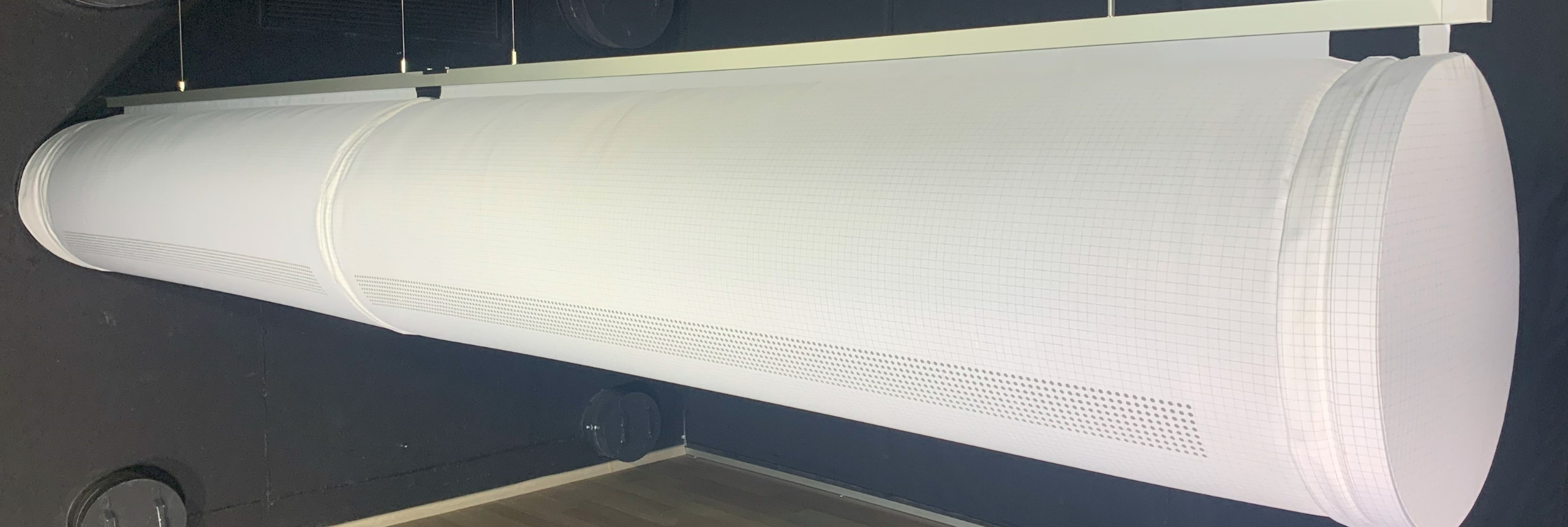
To prevent charge accumulation, antistatic fabric air ducting incorporates conductive yarns woven into a grid pattern, ensuring uniform conductivity across the entire duct surface. These yarns provide a low surface resistance—measured at <2×10³ Ohms in accordance with EN 1149-1—well below the maximum threshold of <2.5×10⁹ Ohms required by antistatic standards.
To maintain conductivity across the entire system, metal press buttons (snaps) are integrated at each zipper connection between duct sections. These snaps ensure electrical continuity between segments and can also serve as connection points for grounding wires. Proper grounding is essential and must be carried out in accordance with local regulations by a qualified safety engineer or specialist. The durable, washable fabric retains its antistatic properties throughout the product’s lifespan, ensuring long-term effectiveness without degradation over time.
Antistatic properties are retained throughout the duct’s lifecycle—even after repeated wash cycles—making this solution a long-term safeguard in sensitive installations.
Applying Antistatic Solutions in Real-World HVAC Projects
Antistatic fabric air ducting not only addresses the risk of ESD but also offers additional operational advantages. By preventing charge buildup, it eliminates the risk of ESD-related sparks or damage, reduces dust accumulation on duct surfaces, and maintains a safer environment for both personnel and equipment. This is particularly beneficial in environments where uninterrupted operation is critical, such as data centers and electronics production lines.
Additionally, the lightweight and flexible nature of fabric air ducting simplifies installation, reduces structural load, and allows for more adaptable airflow design. Combined with reliable antistatic performance, these benefits make antistatic fabric air ducting a practical choice for HVAC engineers seeking effective and safe air distribution solutions in sensitive environments.
Additional Information
Get valuable content first
Enter your email and be among the first to get tips and articles from our experts about HVAC industry topics.