









What is ductwork? A clear guide for HVAC applications


Ductwork is one of the core components of any heating, ventilation and air conditioning (HVAC) system. Although ducts are usually hidden above ceilings or inside walls, they play a major role in how air moves through a building and how comfortable indoor spaces feel.
A well-designed duct system ensures that fresh air is delivered where it is needed and that stale air is removed efficiently. At the same time, ductwork design affects energy use, indoor air quality, and noise levels within the building.
This article explains what ductwork is, the most common types used in HVAC systems, and why the design and material of ducts matter for overall building performance.
Quick definition
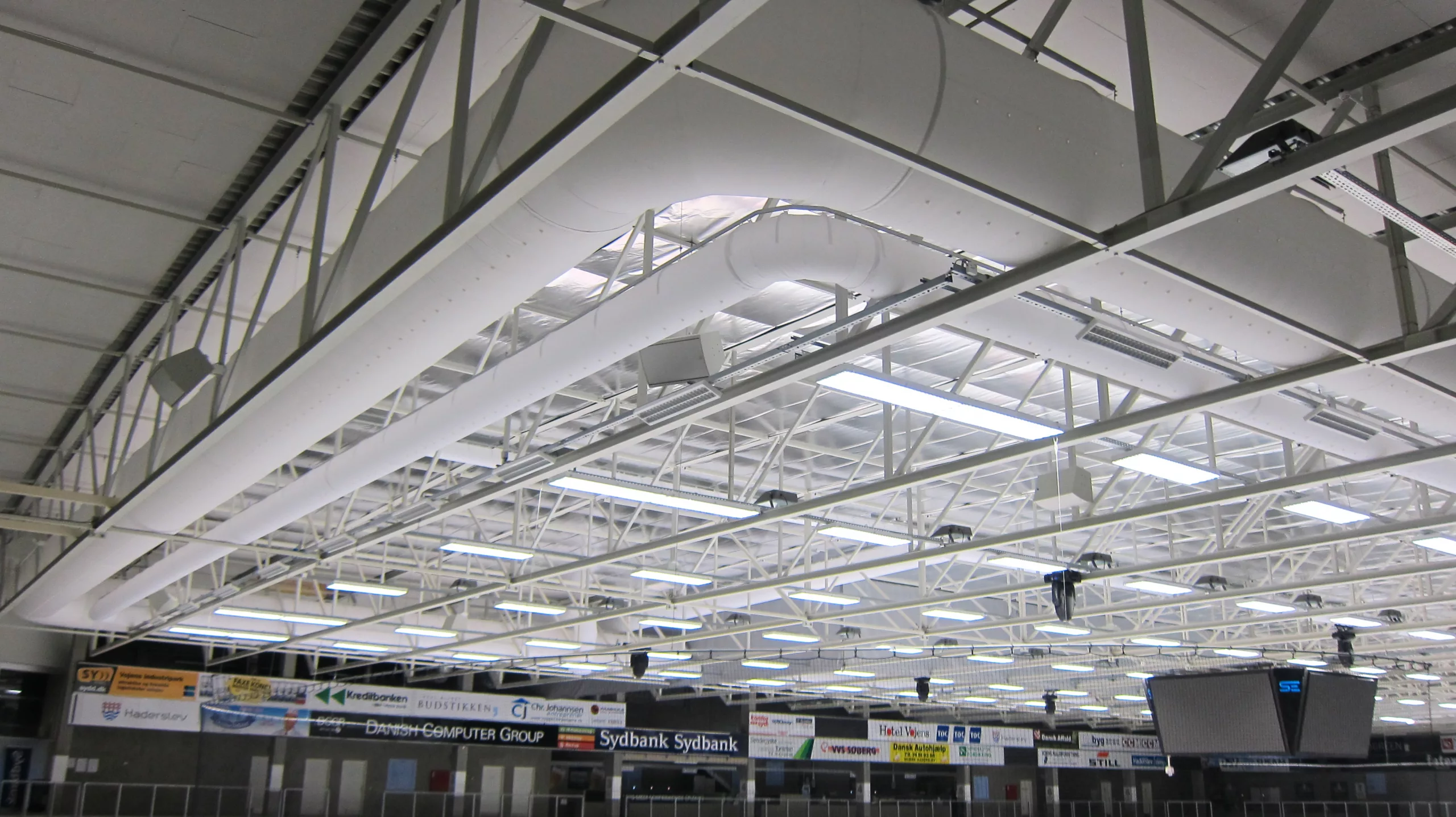
Ductwork is the network of ducts that transports air through a building’s HVAC system.
It connects air-handling units, heating or cooling equipment, and ventilation systems with indoor spaces. The duct system ensures that conditioned air reaches occupants while stale air is removed from the building.
In simple terms, ductwork is the air distribution infrastructure that allows HVAC systems to function effectively.
What ductwork does in practice
In everyday HVAC operation, ductwork supports several important functions:
• Delivering heated or cooled air to maintain comfortable indoor temperatures
• Supplying outdoor air for ventilation
• Removing humidity, odors, and airborne pollutants
• Supporting filtration and air circulation across the building
In larger buildings such as offices, production facilities, or sports arenas, duct systems are especially important because they help maintain consistent airflow across multiple rooms and zones.
Poorly designed ductwork can lead to uneven temperatures, higher energy consumption, and uncomfortable drafts.
Common ductwork systems
Several materials are commonly used for air distribution in HVAC systems. Each type has different installation requirements and performance characteristics.
Metal ductwork
Metal ductwork, typically made from galvanized steel or aluminum, has long been a standard solution for HVAC air distribution.
Metal ducts are valued for their structural strength and ability to handle higher pressure systems. However, they often require additional components and planning to function effectively.
For example, metal duct systems typically need:
• insulation to prevent heat loss or condensation
• careful sealing to avoid air leakage
• diffusers or grilles to distribute air into occupied spaces
Another challenge is condensation and corrosion. In humid environments, condensation can accumulate on metal surfaces, which may eventually lead to corrosion if not properly managed.
While metal ductwork is widely used, this does not necessarily mean it is the most efficient option for air distribution in every application.
Flexible ductwork
Flexible ducts are lightweight ducts made from plastic or foil materials supported by a spiral wire structure.
They are often used for short connections between rigid ducts and air diffusers because they are easy to route around obstacles during installation.
However, flexible ducts typically create higher resistance to airflow, especially when bent or compressed. For this reason, they are usually used only for short sections of ductwork rather than as the main air distribution system.
Fabric ductwork
Fabric ductwork — also known as textile air dispersion — distributes air along the entire length of the duct instead of relying only on end diffusers.
Air is supplied through engineered perforations, nozzles, or permeable fabrics that allow air to disperse evenly throughout the space. This helps create more uniform airflow and reduces temperature stratification.
Fabric ducts offer several practical advantages in HVAC design:
Uniform air distribution
Air is supplied along the duct length, which helps eliminate drafts and creates more even temperatures across the space.
Lightweight and fast installation
Textile ducts are significantly lighter than metal ducts, which simplifies installation and reduces the need for heavy structural support.
Design flexibility
Fabric duct systems are available in multiple shapes, sizes, and colors, allowing them to integrate into architectural designs or exposed ceiling environments.
Resistance to corrosion
Unlike metal ducts, textile ducts are not affected by rust or corrosion caused by condensation.
Fabric air dispersion systems are used across a wide range of applications including offices, warehouses, food production facilities, sports arenas, and retail environments.
Manufacturers such as FabricAir provide detailed installation guides and technical documentation, including step-by-step instructions and video demonstrations that support HVAC contractors during installation.
Myth vs reality
Myth: Ductwork only transports air
In reality, duct design strongly influences building comfort and HVAC efficiency.
Air distribution systems affect:
• indoor air quality (IAQ)
• temperature consistency
• system energy consumption
• noise levels from airflow
Poor duct design can create uneven airflow, pressure losses, and inefficient system operation. This is why airflow calculations and diffuser design are an important part of HVAC engineering.
Myth: All ductwork performs the same
Different duct materials and air distribution strategies create different airflow patterns.
For example:
• Metal ducts typically deliver air through diffusers placed at specific locations.
• Flexible ducts are mainly used for short connections.
• Fabric ducts distribute air continuously along the duct length.
These differences influence installation complexity, airflow performance, and long-term maintenance requirements.
Summary
Ductwork is the air distribution network behind HVAC performance.
Although it is rarely visible after installation, the design and material of duct systems strongly influence how air moves through a building and how comfortable indoor spaces feel.
Choosing the right duct solution — and designing it correctly — can improve airflow consistency, indoor air quality, and energy efficiency across the entire HVAC system.
Get valuable content first
Enter your email and be among the first to get tips and articles from our experts about HVAC industry topics.