



Fabric Ducts vs. Flex Ducts: What's the Real Difference?


Flex duct and fabric duct are both flexible, both lighter than rigid metal ductwork, and both frequently positioned as easier alternatives to sheet metal, which is exactly why the two are so often confused with one another. But the resemblance stops at the surface.
The confusion, however, hides the one distinction that actually matters: flex duct transports air, while fabric duct diffuses it.

Lauris Rezgals-Kalpmanis
Group Product Manager, Europe
That single functional difference, transporting air versus distributing it, is what determines how each system is built, where it can be installed, and what it can achieve. That difference is not a matter of preference or building type. Choosing one over the other based merely on cost or appearance alone can lead to poor air distribution, condensation, or a system that simply can’t do the job it was installed for.
The Core Difference: Transport vs. Diffusion
Flex duct behaves like any other duct: it carries a volume of air from point A to point B. The air enters at one end and exits at the other, through a register, grille, or connection to another section of ductwork. The duct itself plays no role in how that air is spread through a room, since that job is left to a diffuser, grille, or other air terminal device.
On the other hand, fabric duct is the diffuser. Air is released continuously along its entire length, through engineered holes, nozzles, or a permeable weave, rather than at a single terminal point. Thus, fabric duct is a combination of both air transportation and air distribution over the occupied space. This characteristic defines the product. Because the fabric duct itself distributes air throughout the space, occupied areas receive a steady, even flow rather than air arriving only at isolated diffuser points.
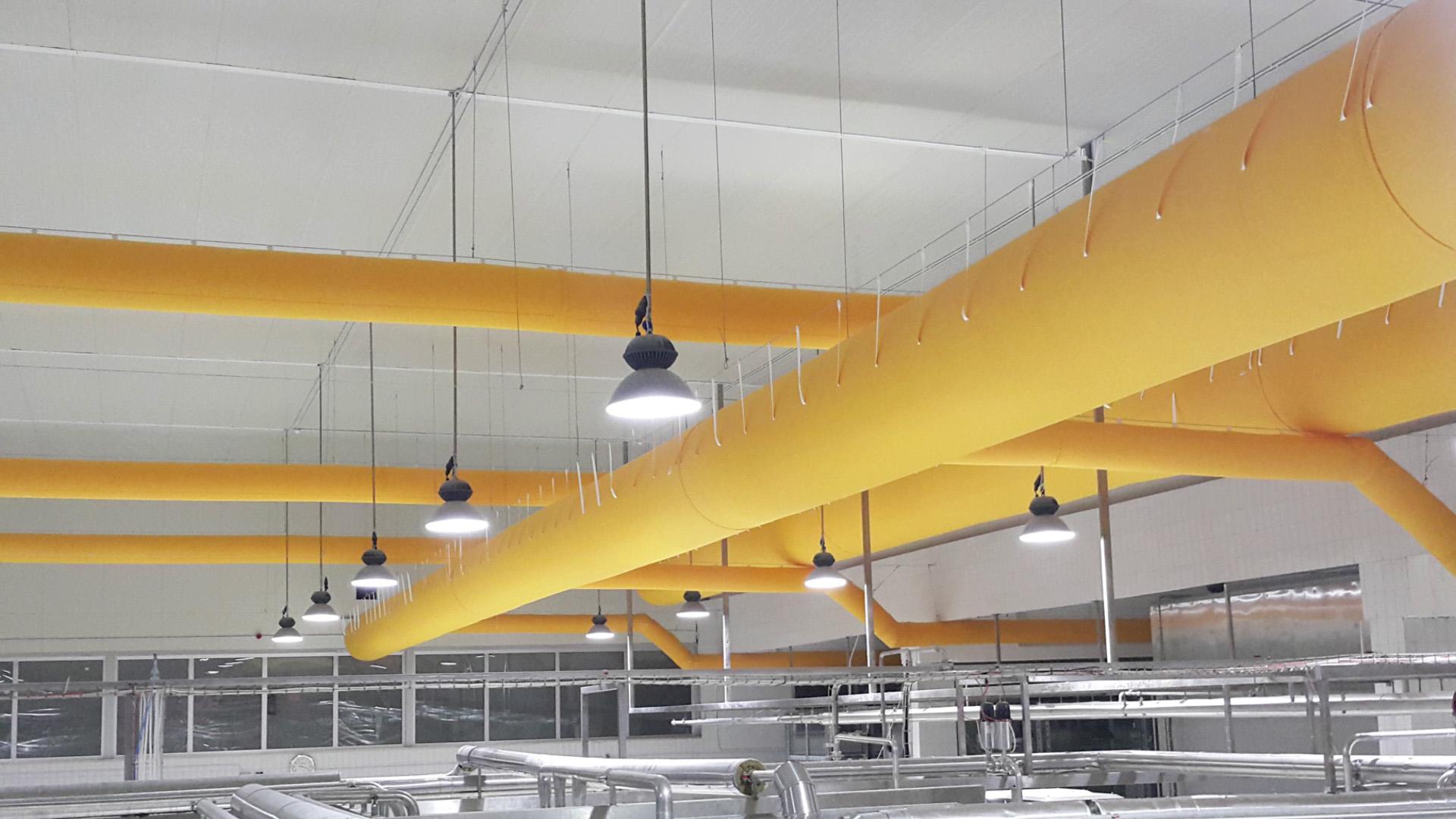
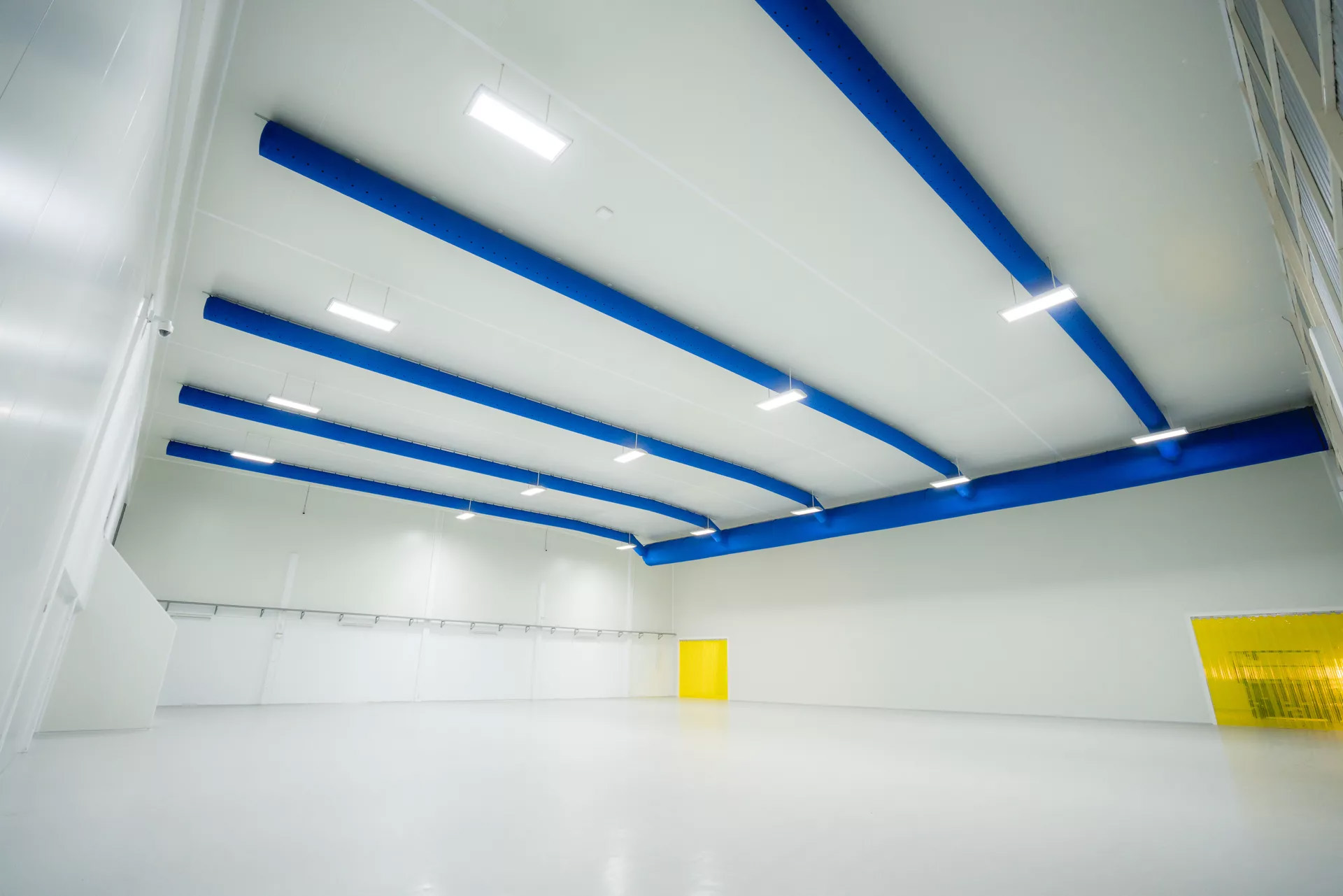
This distinction has a direct, practical consequence: flex duct is typically concealed above a ceiling or behind a wall, since it’s simply carrying air to where it needs to go. Fabric duct, by contrast, is installed exposed and visible in the occupied space. It has to be, since air is exiting through its surface on its path to reach the people, animals, equipment, or product it’s meant to serve. This is also why fabric ducts are engineered with aesthetics in mind: custom colors, printed branding, and clean profile shapes. In contrast, flex ducts are generally finished in a plain plastic or foil jacket that is not too nice to look at, since it is technically not intended to be seen.
Where Each System Fits
Fabric duct fits applications where the goal is even air distribution across an occupied space:
- Warehouses or manufacturing plants, where consistent airflow is needed to preserve the product
- Gymnasiums, arenas and other large spaces where uniform temperature and airflow become vital for a comfortable experience
- Food processing, cold storage, and cleanroom environments, where washable, antimicrobial fabric and non-condensing performance support hygiene requirements
- Any space where comfort and consistency for occupants — human or animal — depend on avoiding hot spots, cold spots, and drafts
- Quiet environments such as schools, churches or museums where a quiet system that reduces noise is needed.
Because flex duct only moves air, it is to be installed in areas where transport, and not diffusion, is the actual requirement:
- Local fume, smoke, or dust extraction, where contaminated air simply needs to be pulled and carried out
- Connecting a rigid metal plenum duct to each single diffuser in false ceiling and similar installations.
- Short, tight, or awkward runs where a rigid metal duct can’t easily bend around obstacles
That last point also describes flex duct’s most common real-world role: it isn’t typically installed as a distribution system in itself, but more so as a connector piece within a metal ductwork system that can ease the alignment of two components or navigate corners, tight joists and hard-to-reach sections on its own. In other words, flex duct is usually there to patch around the limitations of metal ductwork. Conversely, flex ducting is not usually found around fabric ducting systems, since fabric solves those problems by design.
It’s worth being precise here: this is not a residential-versus-industrial distinction. Flex duct can be found in industrial buildings, and fabric duct can be installed in a residential setting where whole-room diffusion is desired. The determining factor is always function: whether the application calls for a duct that carries air, or one that distributes it evenly throughout the space.
Condensation and Environmental Performance
In conditions where the dew point is reached and the condensation would form on the surface of a simple metal, plastic or foil duct, the airflow through the Fabric duct’s permeable surface prevents that from happening and remains condensation-free. This makes it a reliable choice in humid or temperature-variable environments, such as swimming pools, cold storage rooms or greenhouses, without the drip and corrosion risk that affects uninsulated metal ductwork.
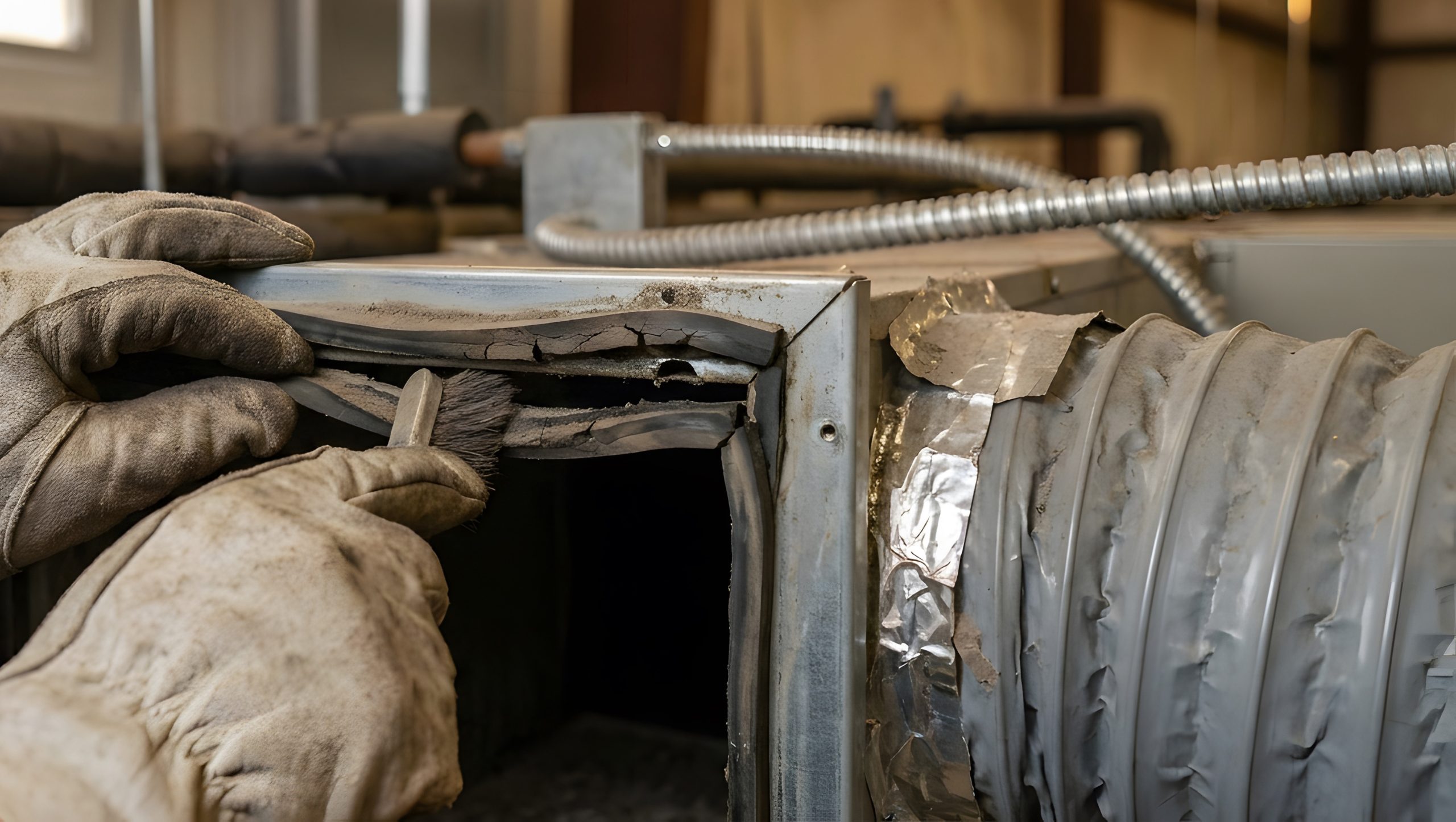
Flex duct, by contrast, is prone to condensation on its outer surface when the air it carries is significantly colder than the surrounding environment and the dew point is reached, unless it’s properly insulated with a continuous vapor barrier. In practice, flex duct’s insulation is one of its less ecofriendly and more failure-prone components. It compresses over time and gets easily damaged during maintenance work, which is when condensation problems tend to appear.
Materials and Construction
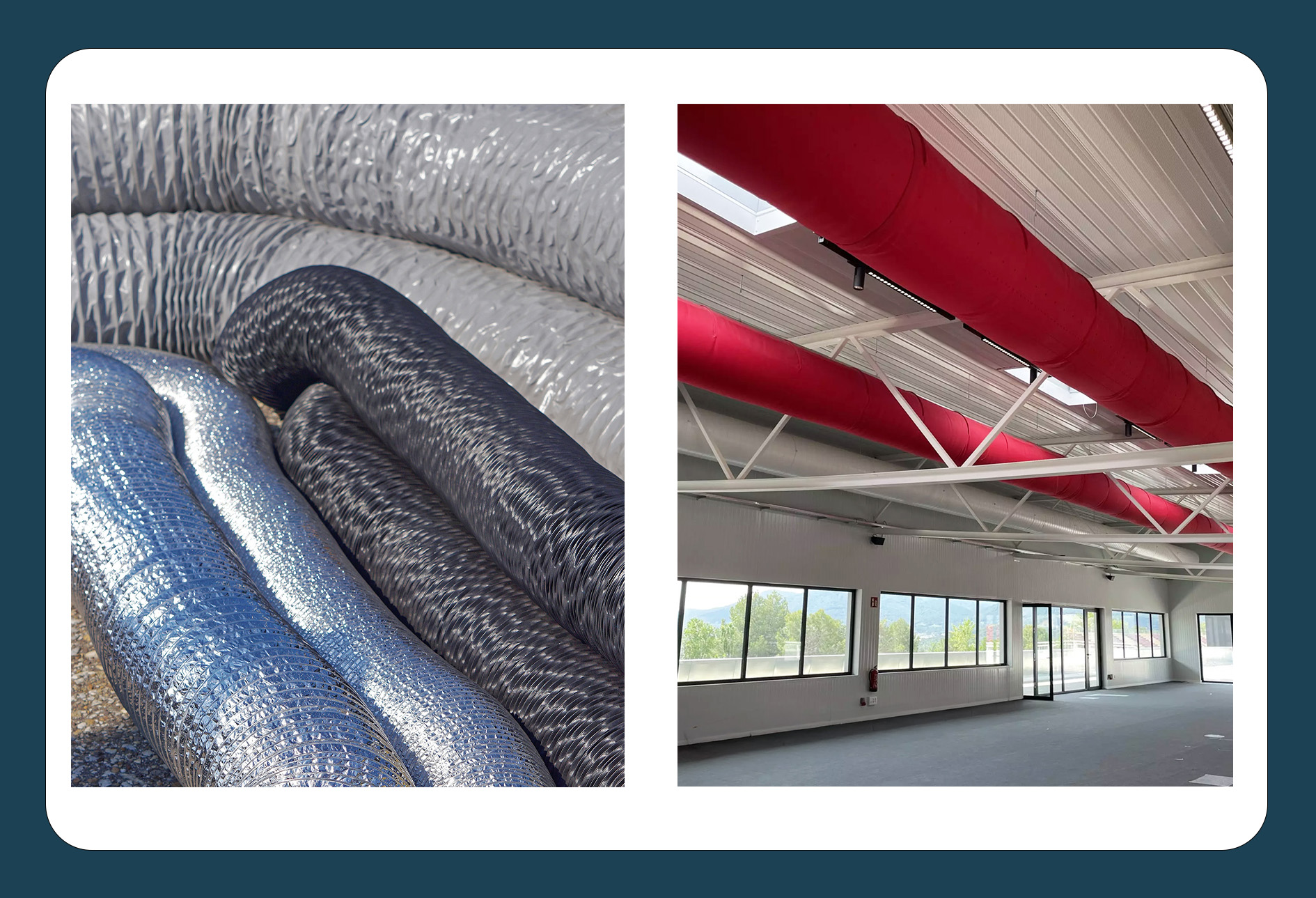
- Flex duct: A wire coil core, plastic or foil liner, insulation (fiberglass or foam), and an outer vapor jacket, built to move and, when insulated, thermally protect air over a defined run.
- Fabric duct: A single layer engineered textile, frequently treated with antimicrobial, flame-retardant or antistatic finishes, suspended from a rail or cable system and custom-engineered to perfectly fit a given space. It requires no extra insulation and can be produced on custom colors or prints.

Cost: Which One Is Cheaper?
On a per-foot basis, flex duct is almost always the cheaper product. It’s a commodity item, mass-produced and sold by the foot, which is exactly why it’s the default quick fix for short connector runs and tight-space transitions.
Fabric ducting carries a higher material cost, since each system is tailored by engineers for a specific space, rather than mass-produced. That said, the cost comparison looks different when measured over the system’s lifecycle rather than at the point of purchase. Due to its lower impact on building structure, easier maintenance and energy efficiency, fabric ducts usually end up being the most efficient investment in the long run.
Still, comparing the cost of flex and fabric ducting isn’t really a meaningful exercise, since the two are rarely installed to do the same job. The more relevant cost comparison is against metal ductwork, which fabric duct (in open ceiling across the room) was designed to replace and flex duct is usually complementary to.
Fabric duct sections generally require less labor to install than metal, since they zip together with basic tools rather than needing to be cut, sealed, and supported section by section. Condensation prevention is a built-in feature requiring no extra material and labor. The linear and even air distribution across the entire room ensures efficient ventilation and thermal performance avoiding the dead zones and cold spots, making it an energy efficient system. And where metal ductwork can corrode, develop leaks at seams and joints, and require recoating or partial replacement over time, fabric duct, properly specified and cleaned, commonly remains in service for well over a decade with routine washing as its main upkeep.
Making the Right Choice
Fabric duct and flex duct are not interchangeable products competing for the same job, they perform two different functions. Flex duct transports air from one point to another and does it well in short runs, tight spaces, and extraction applications. Fabric duct diffuses air across an entire space, delivering the even, draft-free, condensation-free distribution that occupied environments depend on.
The right question isn’t which system is better, it’s whether the application requires air to be moved or distributed. Once that’s established, the appropriate choice tends to follow.
Not sure which system fits your project?
Talk to a FabricAir expert about your space, airflow requirements, and environment, and we’ll help you find the right fit.
Additional Information
Fabric Ducts Solve the Humidity Problem at Silainiai Swimming Pool | FabricAir
Fabric Ducts Bring Zone-by-Zone Climate Control to Enjoy Albacete Sports Center in Spain | FabricAir
FAQs
The simple answer is “nothing.” A sock is a ventilation duct created in fabric instead of sheet metal or pvc pipe. The technology is widely used across the globe, which means it’s a technology with many names.
In Europe, where the technology was first commercialized, it typically is known as fabric ducts, fabric air dispersion, or textile-based ducting. Whereas the same technology is known as air socks or simply socks in North America and textile channels across Europe.
Regardless of which expression is used, fabric ducts have unique technological characteristics that set the solutions apart from steel ducts, Spiro ducts and other HVAC ducts in sheet metal.
Fabric ducts do not have the same natural tendency toward sweating as other HVAC ducts do. Permeable textiles prevent the formation of condensation on the ductwork, which is why fabric ducting does not require insulation.
The technological advantages of fabric ducts are many, the most prominent of which is the even and draft-free air distribution. The high levels of comfort and hygiene set fabric-based solutions apart from traditional metal HVAC solutions. It is easy to maintain and wash. The fabric used for air distribution systems is antimicrobial and can be flame retardant (depending on the fabric used). In addition, fabric-based solutions are designed to be lightweight, therefore, they are extremely easy to install without using heavy machinery.
Get valuable content first
Enter your email and be among the first to get tips and articles from our experts about HVAC industry topics.