


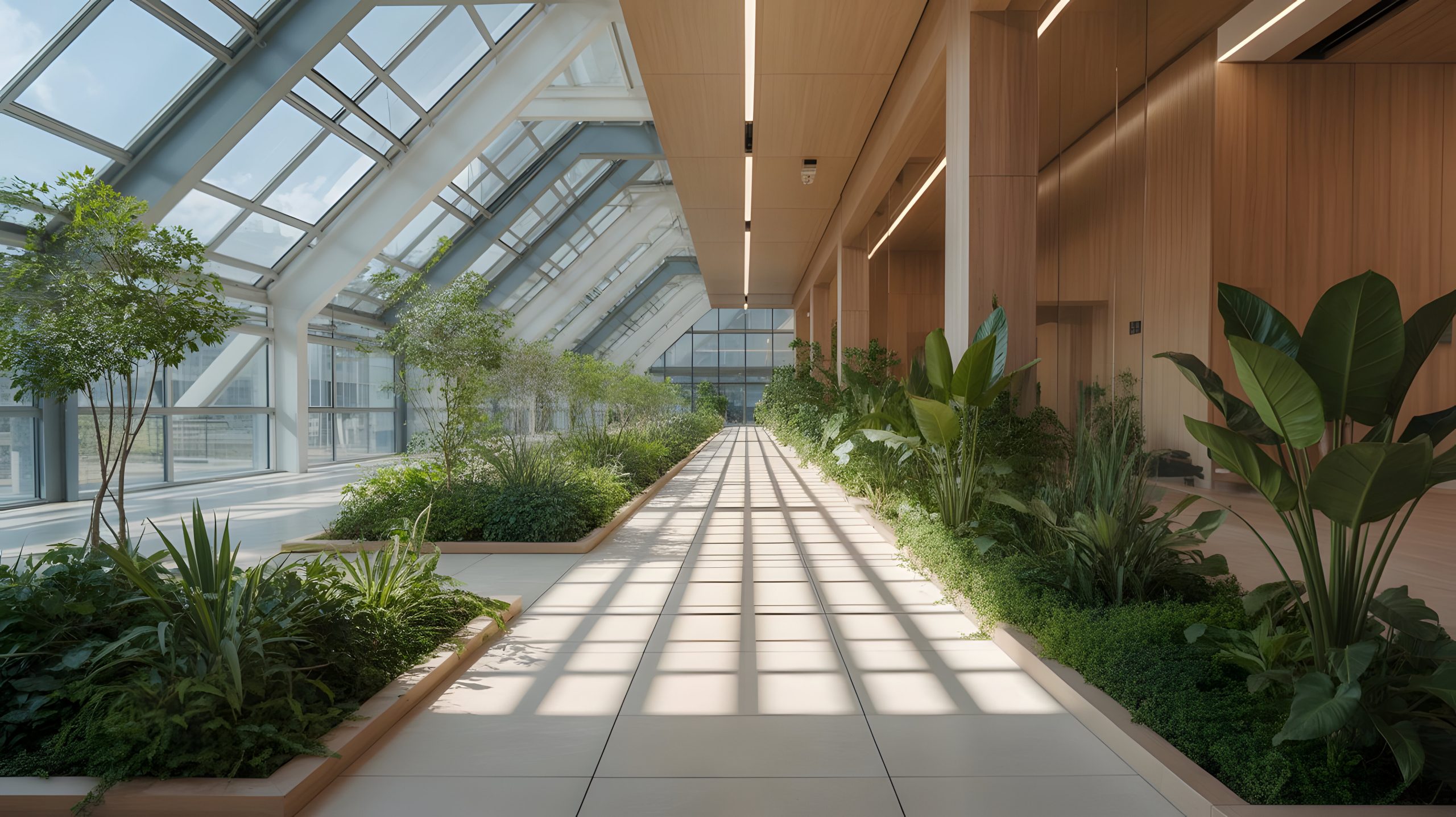
Building Decarbonization: How Fabric Duct HVAC Plays Its Part


Building decarbonization means reducing the greenhouse-gas emissions associated with a building across its whole life. For design teams, this is commonly divided into three connected areas: embodied carbon, operational carbon and end of life.
Air distribution is relevant to each part of that framework. Material quantity, production method, transport and suspension influence embodied impacts. System pressure and fan power influence operational energy. Durability, washability, disassembly and material composition influence service life and end-of-life options. Taken together, this means air distribution can measurably contribute to building decarbonization.
Embodied Carbon: Materials and Suppliers
Embodied carbon includes emissions associated with raw-material extraction, manufacturing, transport, installation, replacement and end-of-life processing. These emissions occur before and during the service life of the building, independently of the energy later used for heating and cooling.
From an HVAC perspective, fabric duct systems can contribute to lowering the embodied carbon of a project.
One of the main reasons lies in their light weight. Combi 90 fabric, featured in FabricAir’s EPD (Environmental Product Declaration), has a fabric mass of 300 g/m2, and other FabricAir fabric choices weigh even less. Even with the suspension system, zippers, connectors and other components required to install them, fabric ducts remain lightweight.
Low material mass also reduces several upstream impacts. Fabric ducts can be folded into compact packages, require less freight volume and are easier to handle on site.
Producing and transporting lighter material takes less energy. FabricAir project-specific carbon calculations have reported transport-related CO2 emissions up to 21.3-fold lower in selected comparisons with metal ductwork.
Lower suspended mass can also reduce the load placed on roofs, ceilings and support systems. This is particularly relevant in retrofit, long-span and structurally constrained projects. Any avoided secondary steel or reinforcement should only be counted in a carbon assessment when it is confirmed in the structural design, rather than assumed from product weight alone.
The choice of supplier also plays an important role. FabricAir:
- Has completed a Life Cycle Assessment (LCA) conducted by Kaunas Technical University (KTU)
- Calculates carbon emissions for every project
- Has a public EPD that follows EN 15804+A2 and ISO 14025 principles and can be used as product-level evidence in whole-building assessments.
| FabricAir technical reference | Declared value or design note |
|---|---|
| Declared unit | One ventilation duct with 1 m2 of fabric, including the materials required for the relevant suspension system. |
| Reference Service Life | 30 years as an LCA modelling assumption; this is not the same as a product warranty or a guarantee of actual service life. |
| GWP-total | 5.85 to 11.7 kg CO2e per declared unit, depending on suspension configuration, as reported in EPD MD-24129-EN. |
| System boundary | Modules A1 through C4, with potential benefits and loads beyond the system boundary reported separately in module D. |
| Reference fabric mass | 300 g/m2 for the Combi 90 fabric used in the EPD; installed mass varies with suspension and accessories. |
| Design support | Project-specific carbon calculations, engineered airflow layouts, CFD assessment and BIM/Revit workflows. |
Operational Carbon: Efficiency and energy use
Operational carbon comes from the energy a building uses to run once it opens. Envelope performance, heat sources, cooling equipment, heat recovery, controls and grid carbon intensity all matter.
In fact, HVAC operations are one of the key points affecting energy efficiency, since by definition they are among the most demanding processes a building needs to keep running.
Efficient HVAC can have a noticeable impact on energy use and efficiency. A system that keeps temperatures stable puts less strain on heating and cooling equipment, and that lower strain means lower energy demand overall.
On the air side, the fan must deliver the required airflow against the total pressure resistance of the system. This is why HVAC efficiency cannot be evaluated only from a heat pump COP, chiller EER or equipment label. Auxiliary electricity for fans is part of the same building energy balance, and it continues for every operating hour of the system. At the same airflow and comparable efficiency, lower pressure demand means lower fan input power. A fabric duct does not remove pressure losses elsewhere in the air-handling system. Its influence is on the downstream distribution and terminal portion of the pressure budget.
At a fixed airflow, reducing the required pressure at the same fan-system efficiency reduces fan input power approximately in proportion to that pressure reduction.
A conventional metal system normally transports air through rigid ductwork and then discharges it through separate grilles, diffusers or jet outlets. A fabric air-dispersion system combines transport and terminal distribution along the duct length through engineered permeability, laser-cut perforations or nozzles.
Even distribution helps minimize the stratification that leaves warm air pooling near the ceiling. This same approach can also reduce drafts. Because conditioned air exits along the full length of the duct rather than through a limited number of outlets, an even temperature is easier to maintain across a room, regardless of its size. The system holds that stability continuously while it runs, rather than repeatedly working to recover it by pushing air into a few points in the room. The potential operational benefit comes from avoiding excess airflow, aggressive supply temperatures or prolonged operating hours used to compensate for uneven distribution.
End of Life: Built to Last, Easy to Maintain
Waste generation is one of the central concerns in any sustainability strategy. But end-of-life strategies start long before disposal. The priority is to keep a product in service through appropriate material selection, maintenance and repair. FabricAir supports that goal through the long life of its materials. Warranty conditions may vary by fabric, application and approved use, but selected products carry a 10-year warranty and the Combi 90 EPD uses a 30-year Reference Service Life for LCA modelling.
Proper care and maintenance can help extend the life of the product. Fabric ducts can be divided into zippered sections, removed from the suspension system and machine-washed. Removable sections can reduce maintenance access requirements and allow damaged sections to be replaced without removing the entire distribution system. Where continuity is critical, a spare set can be rotated during laundering.
Recycling comes into play once continued use and reuse are no longer practical. Relevant low-permeability Combi Eco variants avoid a PU coating, which simplifies the fabric’s material structure. However, successful recycling still depends on suitable collection and a recycler able to process the material.
Success Stories: Decarbonization in Practice
Fabric ducting changes the material and pressure requirements of the air-distribution layer, and it can improve maintainability and future circularity when the system is designed accordingly.
When those elements are documented, fabric ducting can contribute across all three parts of building decarbonization: lower material and production impacts before operation, lower fan energy during operation, and longer service and easier disassembly at the end of life.
A few FabricAir projects show how fabric ducting can contribute when it is integrated into a complete HVAC and building strategy. At a Danish Crown food processing facility in Blans, Denmark, fabric ducts installed in 1977 are still running today. That is a real example of the service life advantage described above.
A published FabricAir design comparison shows how lower pressure translates into fan energy. The comparison covers a 25 x 25 m room with an airflow of 8,000 m³/h. The balanced metal layout required 160.8 Pa, while one fabric configuration required 110.8 Pa. These figures apply only to the designs compared. Actual savings depend on the complete system, the fan selection and the operating profile.
A production facility in Türkiye received the “Sustainable Development Goals Compliant Production Award in the Food Category” for its sustainable production approach, and a pharmaceutical warehouse in Spain fitted with a FabricAir fabric duct system is the first building of its kind to achieve a Passivhaus certification.
FAQs
Building decarbonization means reducing the greenhouse-gas emissions a building causes over its whole life cycle. These emissions fall into two main groups. Operational carbon comes from the energy used to heat, cool, ventilate and run the building. Embodied carbon comes from producing, transporting and installing materials, and from maintenance, replacement and end-of-life processing. HVAC systems influence both groups, through the materials they contain and the energy they need to run.
Related terms: building decarbonization, whole-life carbon, life cycle, embodied carbon, operational carbon, HVAC
Operational carbon comes from the energy a building uses once it is in operation. The building envelope, heating and cooling equipment, heat recovery, controls and the carbon intensity of the grid all affect it. HVAC is among the most energy-demanding processes in a building, so its efficiency has a clear effect on operational carbon.
Related terms: operational carbon, building energy use, HVAC efficiency, grid carbon intensity
When air is spread evenly, warm air is less likely to pool near the ceiling and drafts are reduced. As a result, the room is easier to keep at a stable temperature. The system then does not need extra airflow, more aggressive supply temperatures or longer operating hours to make up for uneven distribution.
Related terms: air distribution, stratification, drafts, thermal comfort
The fan must deliver the required airflow against the total pressure resistance of the system. At the same airflow and fan efficiency, a lower pressure requirement means lower fan input power. Fans run for every operating hour of the system, so pressure has a direct effect on operational energy.
Related terms: pressure loss, static pressure, fan energy, airflow, operational carbon, HVAC efficiency
Fabric ducts can be divided into zippered sections, removed from the suspension system and machine-washed. Damaged sections can be replaced without removing the whole distribution system. Where continuity is critical, a spare set can be rotated during laundering.
Related terms: fabric duct maintenance, washable ducts, service life, end of life, HVAC
Decarbonizing a building means reducing emissions across its whole life cycle. The work involves the entire building, and the HVAC system is one important part of it.
Start with a whole-life carbon assessment at the design stage. Where possible, renovate and reuse existing buildings instead of demolishing them. Reduce energy demand with good insulation, airtightness, efficient windows and passive design, such as orientation and shading. In addition, choose low-carbon materials and design for disassembly, so components can be reused later. Finally, switch to a clean energy supply, such as on-site solar panels or renewable electricity.
Replace fossil-fuel boilers with efficient heat pumps, and size the system for the actual loads instead of oversizing it. Add heat recovery and demand-based controls to avoid wasting energy. Keep system pressure low, so fans need less power. Distribute air evenly to avoid stratification and drafts. Lastly, commission the system properly and maintain it, so it keeps its performance over time.
Related terms: how to decarbonize a building, whole-life carbon, retrofit, energy efficiency, insulation, renewable energy, heat pumps, HVAC design
Get valuable content first
Enter your email and be among the first to get tips and articles from our experts about HVAC industry topics.