


How modern ventilation solves heat stress in dairy barns


In every season, barn climate determines how well cows eat, rest, and produce. A stable, healthy environment isn’t a luxury – it’s the foundation of herd performance.
Barn ventilation – a year-round priority
Barn ventilation is often seen as a summer concern. But in reality, managing air quality and temperature inside barns is essential all year. During winter, moisture from cows’ breath and manure mixes with warm indoor air, leading to condensation, damp bedding, and ammonia build-up. These conditions increase the risk of respiratory issues, mastitis, and hoof problems.
At the same time, each cow generates about 1,000 watts of body heat, similar to a small heater. Without consistent air exchange, that heat accumulates even in cold weather. The result is higher humidity, stale air, and a gradual rise in the Temperature-Humidity Index (THI) – a key measure of cow comfort. Cows begin to experience stress when the THI exceeds 68, even if it doesn’t feel particularly warm to us.
Understanding Cow Comfort
Cows are most comfortable between 5°C and 20°C. Outside that range, they must work harder to regulate body temperature. Poor airflow, damp air, or high ammonia levels all add stress. When that happens, cows spend less time lying down and ruminating, eat less feed, and produce less milk.
Good ventilation helps keep the barn dry, prevents condensation, and maintains fresh air around the animals. The result is a calmer, healthier herd that performs consistently, regardless of the weather outside.
What Poor Ventilation Really Costs
Studies from European research institutes show that poor air quality and heat stress can:
- Cut milk yield by up to 20% when ventilation is insufficient.
- Reduce fertility rates by 30–50%, affecting reproduction cycles.
- Increase somatic cell counts and udder infections.
These issues are not seasonal. In many modern barns, insulation and heat retention make winter just as challenging as summer when it comes to maintaining air quality.
Why Traditional Systems Fall Short
Many barns around the world still depend on ridge vents, open sidewalls, or simple fans. While these help move air, they rarely provide consistent conditions throughout the barn. Airflow near fans can be strong, but corners, cubicles, and feeding zones often remain stagnant.
In cold weather, farmers sometimes reduce ventilation to keep warmth inside. Unfortunately, this traps humidity and ammonia, creating damp, unhealthy air.
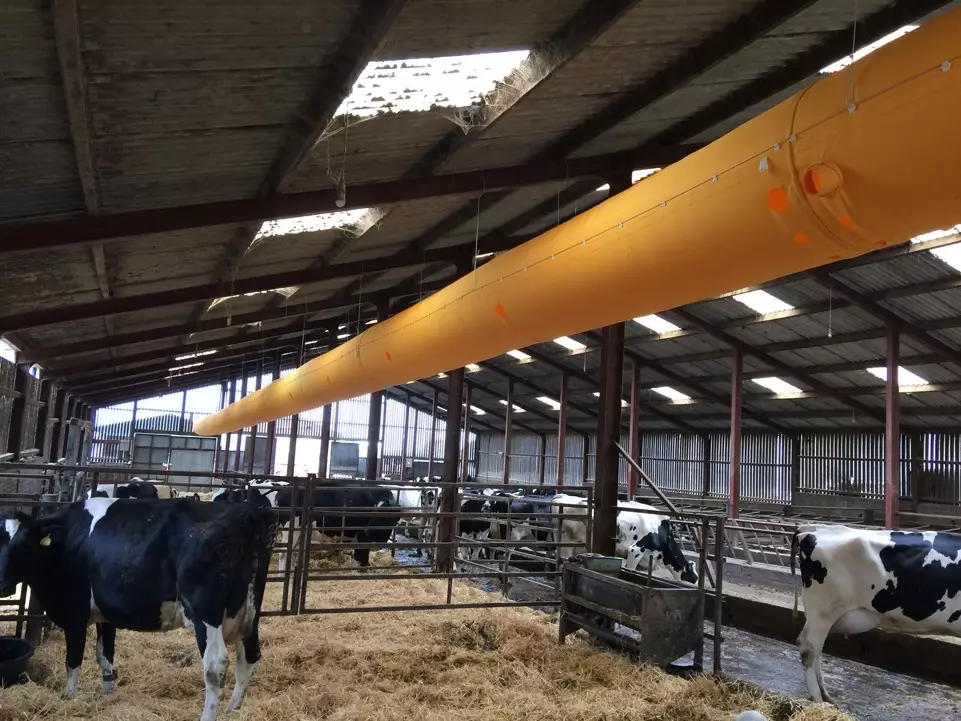
Metal ducts distribute air unevenly – strong near outlets, weak elsewhere. By contrast, fabric ducts distribute air evenly along the entire length of the barn through thousands of small perforations. Their permeable surface prevents condensation and maintains a steady, gentle airflow. The textile is lightweight, washable, and resistant to corrosion, allowing for easy maintenance and seasonal flexibility.
Effective barn climate control requires this kind of balanced airflow all year – enough to remove heat and humidity, but gentle enough.
The Fabric Duct Ventilation Advantage
Modern fabric duct ventilation systems are changing how farmers approach barn climate. Instead of relying on a few concentrated airflow points, fabric ducts deliver air evenly throughout the barn using either thousands of small perforations or adjustable flow modules, depending on the barn zone. This allows custom-fit airflow precisely where it’s needed, for example, directly over cubicles where cows rest or eat.
This approach provides measurable advantages across comfort, health, and operational efficiency:
Cow Comfort & Performance
- Custom-fit airflow tailored to animal zones for optimal cooling and comfort
- Even air distribution that eliminates hot spots and drafts
- Improved lying times and lower heat stress, directly supporting milk yield
Health & Hygiene
- Reduces bedding moisture and ammonia levels for better air quality
- Keeps surfaces drier, limiting bacteria and odor buildup
- Promotes a cleaner, healthier environment for both cows and staff
Quiet & Stress-Free Operation
- Silent, draft-free airflow helps maintain calm herd behavior
- Uniform cooling effect without disruptive fan noise
Modern dairy farming depends on precision – not just in feeding and genetics, but in air management too. Consistent, even airflow has become one of the most effective ways to protect animal welfare, stabilize milk production, and reduce maintenance costs year-round. Fabric duct ventilation systems bring that precision within reach of every farmer. Their ability to distribute air evenly across all barn zones sets a new standard for barn ventilation. As farms grow and climates continue to shift, investing in smarter airflow isn’t just a technical upgrade, it’s a practical decision for healthier cows, calmer barns, and more reliable performance in every season.
Get valuable content first
Enter your email and be among the first to get tips and articles from our experts about HVAC industry topics.
FAQs about Dairy Barn Ventilation
Cows require a lower but steady rate of air exchange in winter and a much higher rate in summer. A common guideline is about 4 air changes per hour in winter (to remove moisture and gases without chilling the barn) and up to 60 air changes per hour in summer for cooling. In practice, this means the barn air should be completely refreshed about every 15 minutes in cold weather, and as often as once per minute during hot weather. This high summer ventilation rate helps carry away heat and humidity, preventing heat stress. The exact needs vary with barn size, animal density, and outside conditions, but the goal is to keep air fresh in all seasons.
Cows begin to experience heat stress at relatively mild temperatures, often long before humans feel uncomfortable. When this happens, they eat less, ruminate less, and milk yields decline. Proper barn ventilation helps by removing hot, humid air and replacing it with cooler, fresher air. Just as importantly, it creates steady air movement over the cows, producing a wind-chill effect that helps them shed excess body heat.
On-farm practice show that air speeds of about 2–2.5 m/s at cow level are needed on hot days to provide effective cooling. ClimaBarn systems are designed to deliver this consistent, targeted airflow, ensuring cows stay within their comfort zone even during the hottest months.
Yes. Even in winter, cows need fresh air to remove moisture and ammonia that build up in closed barns. Well-designed systems run fans at low speed and diffuse the supply air in a way that it mixes with the room air before reaching the animals, keeping the barn dry and healthy without chilling the cows.
Yes. It runs continuously, day and night, all year. The airflow is automatically adjusted to the temperature in the barn. On extremely hot days, the airflow can be manually increased to full power for extra cooling.
No. FabricAir ventilation systems for barns are made of polyester fabric, which naturally have noise-absorbing properties. This means the fan noise over the length of the duct is absorbed contrary to other hard material systems which allow the noise to transmit. The air dispersing through the fabric surface and the ventilation outlets (orifices or nozzles) makes a steady background hum to which farmers often report that cows quickly adapt and remain undisturbed.
The main difference is that fabric duct systems deliver fresh outside air directly to the animals at high speed, ensuring effective cooling. The air is distributed along the entire length of the duct, eliminating “dead zones” or stagnant spots, so every cow receives a steady supply of fresh outdoor air, no matter where it is in the barn. Fabric ducts work exclusively with outdoor air, functioning much like personalized ventilation for each animal.
In contrast, other solutions such as ceiling fans or overhead axial fans mainly recirculate the barn’s polluted indoor air. These systems follow a “one-size-fits-all” centralized ventilation approach, which often makes it difficult to achieve uniform airflow and guarantee that every cow gets the fresh air and cooling it needs.
Many farmers notice calmer, less stressed animals after installing a fabric duct system. Cows no longer crowd at one end of the barn in search of fresh air or flick their tongues to cool themselves – because they already have consistent, comfortable airflow throughout the barn.